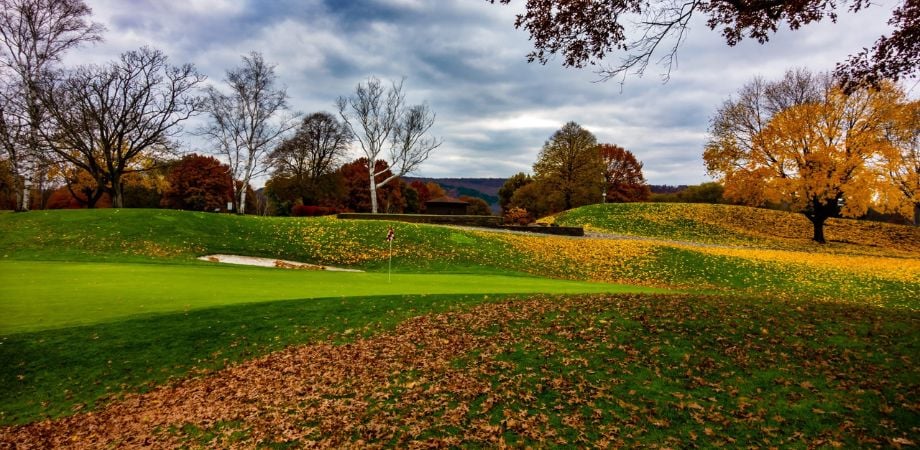
Creeping bentgrasses provide some of the most spectacular, highly-manicured, and highly scrutinized turf surfaces in the world. What traits are most desirable in those surfaces, and how are those traits incorporated into top-performing bentgrass varieties?
Disease resistance is one of the most valuable traits in a bentgrass variety. On golf greens, a disease outbreak can be unsightly, but it can also interfere with the use of the turf by causing irregularities in the putting surface. Preventative fungicides are routinely applied to bentgrass greens, but genetic disease resistance decreases the amount of fungicides that are required to control outbreaks. Reducing fungicide applications is good for the environment and decreases maintenance costs.
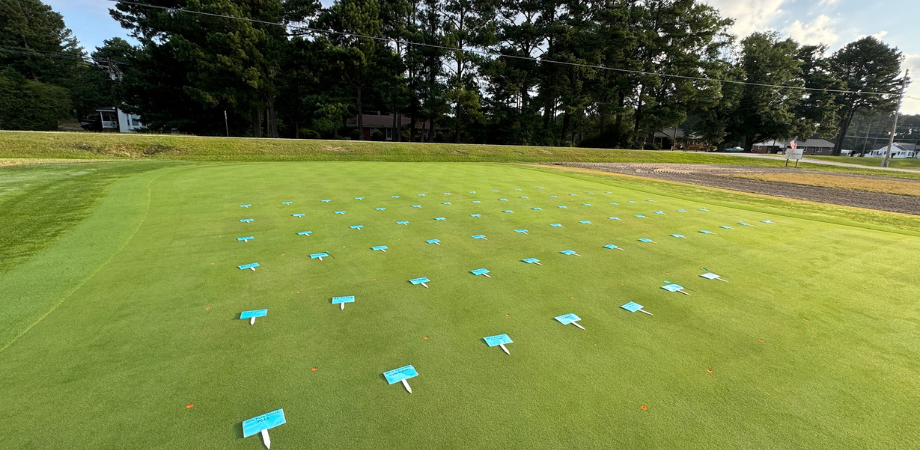
Turfgrass breeders discover genes for disease resistance by collecting plants from existing golf greens or collecting plants from turf areas that are not maintained with fungicides and may have natural disease resistance. These plants are crossed with bentgrasses with other desirable traits, and the resulting experimental varieties are evaluated in turf trials under disease pressure to assess their disease resistance.
Fine leaf texture and high turf density under close mowing are highly valuable traits in the best bentgrass varieties. Turfgrass breeders evaluate bentgrass plants individually in spaced-plant trials to evaluate their morphology. Plants with similar, desirable growth habits are crossed, and the resulting seed is used to establish turf evaluation plots under close mowing. By definition, turfgrasses are grasses that persist under close mowing. Creeping bentgrasses, on golf greens, are required to tolerate extremely low mowing heights, 0.125” or lower. Testing bentgrass varieties under close mowing, ideally in golf course trials, is a great way to discover which varieties can stand up to the low-mowing test.
Genetic color is another trait that distinguishes bentgrass varieties. From light green to bright green to blue green to dark green, architects like a certain color to contrast with the colors of the other grasses on the golf course. Some superintendents might prefer another color. Any color is good, as long as the surface is uniform.
Heat tolerance can be an important trait for creeping bentgrass. Bentgrass is a cool-season species, so its most stressful season is the summertime. That’s also a season when golf turfs are used the most. In Rolesville, NC, we evaluate experimental bentgrass varieties in trials with warm climates that are stressful in the summer, to identify which varieties perform the best.
Finally, high seed yield is an important trait for bentgrass varieties, even though a golfer might not think much about that one. High seed yield and resistance to seed production diseases are important keys to making a variety economical for a farmer to produce and, consequently, affordable for the consumer to purchase. The PST Oregon research farm works on seed yield and improved seed production traits.
All of these traits are key to the development of a top-performing bentgrass variety. It takes over 10 years of dedicated, creative persistence for a breeder to identify and combine these traits to develop such a variety.
Blog authored by Dr. Melodee Fraser, Director of Research, Pure-Seed Testing East