Beginning with the 2027 high school baseball season, several National Federation of State High School Associations (NFHS) rule changes will take effect, with the most notable being the requirement of a double first base.
The Double First Base Requirement
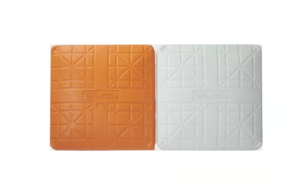
Having a double first base will help lessen the risk of injuries caused by runners and fielders colliding with each other. Rule 1-2-9 says the base must include a white portion in fair territory and a solid-colored portion in foul territory, with the foul line splitting the two sections. There can’t be any space between the two portions of the base.
We carry several compliant options, including a standard double first base, as well as a full base set. We also carry an option that uses a single existing ground anchor for a fast, straightforward setup.
Using the Double First Base
Rule 8-2-2a says that on an initial play, the batter-runner should use the colored portion of the base, while the defensive player should use the white portion. However, if a fielder is pulled into foul territory for a dropped third strike, the batter-runner should use the white part.
If a batter-runner only touches the white portion on a force play and collides with the fielder, it’s considered interference. In the same vein, if a defensive player only touches the colored portion and collides with the batter-runner, it’s obstruction.
Once a batter-runner reaches first base, they have to return to and use the white portion of the base when they’re leading off, returning on a pickoff attempt, or tagging up on a fly ball. The batter-runner can use either side of the base on a walk or on an extra-base hit to the outfield as long as there’s no chance of a play happening at first base.
Additional New Rules
- Rules 2-5-1h and 2-16-1h: A batted ball that hits or bounds over the white portion of the double first base is fair, while a batted ball that hits or bounds over the colored portion is a foul ball.
- Rules 3-4-6 and 2-10-3: Each team is limited to one defensive player-to-player meeting per inning, during the half-inning their team is defending. That meeting is defined as a discussion between two or more defensive players.
- Rule 1-4-4: School names, nicknames, logos, mascots, and/or player names are allowed on uniform tops and/or pants.
- Rule 1-6-3: Players can’t wear audio or video recording devices during a game.
If you have any questions about the new base rule, please reach out to your ATS rep. If you haven’t worked with an ATS rep before, you can find your closest one here.