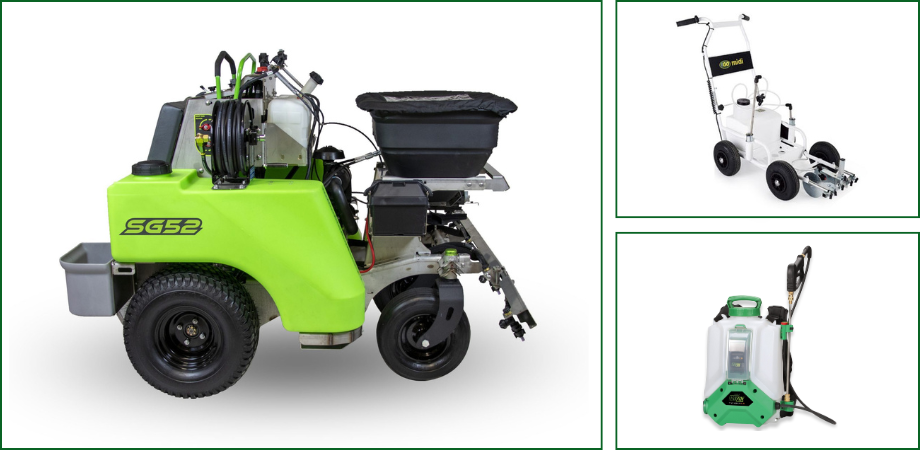
As you prepare your sports fields for winter, it’s important to take the time to properly winterize your equipment, too. Proper winterization will keep your equipment in good working order during the off-season and make for an easy start to the spring.
Winterizing the Linemark iGO Midi Line Marking Machine
The Linemark iGO Midi is a precise, compact machine that helps sports turf professionals mark lines quickly and efficiently. When the season ends, keeping it clean and protected will ensure it performs at its best in the new year.
Thoroughly Clean the Machine
Start by running warm water through the iGO Midi’s pipes, filters, and nozzle. This will help remove some of the leftover paint from inside the machine.
Run Detergent Through the Machine
Next, run undiluted Flush Thru detergent through the system. This solution is formulated to prevent paint residue from accumulating inside the machine, which will prevent clogging and damage. Run the detergent through the iGO Midi until the solution has traveled through the entire system. Once foam appears at the nozzle, it has made its way through the system. After this, let the solution sit for 15 minutes to thoroughly clean the pipes, filters, and nozzle.
Flush the System
After the Flush Thru has had time to remove any remaining residue from inside your iGO Midi, flush the system with warm water for two to three minutes to clear out that residue. Then, remove the probe and let the pump run until the water is expelled. Make sure all the water is removed before turning off the pump.
Remove Parts
Remove the filters and nozzle from the iGO Midi and store them in water during the off-season. It’s also important to charge the battery fully and then disconnect it to avoid power drainage.
Properly Store the iGO midi
Store your iGO Midi in a place that is protected from freezing temperatures. If that’s not possible, make sure to remove the battery, filters, and nozzles and store them indoors to prevent damage. Any leftover paint also needs to be stored in a location that will not freeze over the winter.
Winterizing Backpack Sprayers
Backpack sprayers help sports turf professionals make easy chemical applications, and like any piece of equipment, they need to be serviced regularly. Backpack sprayers should be emptied and rinsed after every use during the season, and winterized when the season is over.
Drain and Flush the Backpack Sprayer
Start by draining the backpack sprayer’s tank to remove any remaining product from the system. Then, add water to the tank and flush the system by spraying. Be sure to spray into a bucket or on an area that the leftover product is labeled for. Repeat this process three times to ensure that no chemical residue is left in the tank.
Use Cleaning Agents When Directed
Some chemical labels specify that only water should be used to clean that specific product out of spray systems, but some recommend the use of detergents. If directed by the label, use a cleaning agent like Erase T&O. Then, run water through the system to clear out the residue and cleaning agent.
Clean Important Parts
Disassemble the backpack sprayer and inspect key parts like the pump, filters, and wand. Inspecting these parts will help you find and remove any hidden debris or buildup that can affect the functionality of the sprayer. Consumable parts, such as filters, can be replaced if needed.
Drain and Dry
Once the backpack sprayer is clean, it’s critical to drain all remaining water. Allow the sprayer to air dry completely before storing it.
Consider Adding RV Antifreeze
If you have to store your sprayer in an area where freezing temperatures are unavoidable, run an antifreeze solution designed for recreational vehicles through the system and recirculate it for several minutes. This will help prevent any internal components from freezing. RV antifreeze should be used because standard automotive antifreeze can cause corrosion and damage your backpack sprayer.
Properly Store the Sprayer
Store your backpack sprayer in a temperature-controlled location, if possible. If you’ve added an antifreeze solution, add water, agitate, and spray out the solution in the spring.
Winterizing Steel Green Machines
Your Steel Green spreader/sprayer needs to be winterized in order to protect its intricate system of spray tanks, nozzles, and other moving parts.
Empty the Tanks and Add Washer Fluid
Make sure your machine’s spray tanks are empty. Then, pour a jug of windshield washer fluid into one of the tanks. Since your Steel Green machine’s tanks are connected, the fluid only needs to be poured on one side.
Check Your Valves and Hose Reel
Next, make sure that the suction valve and return valve are both turned off on one side and are left open on the other. The valves should be left open on the tank that has the washer fluid inside it. Ensure that the machine’s boom valves are shut and that the hose reel is shut off, too.
Turn on the Pump
Before turning on the pump, rotate the pressure regulator fully counterclockwise so the pressure is at zero. Next, start the machine and turn on the pump. If you have a newer machine, turn the key to the accessory position and turn on the pump.
Allow the Washer Fluid to Run Through the Machine
The pump will suck the washer fluid into the machine and run it through the manifold, pumps, and then back into the tank. Let it run for at least 30 seconds.
Then, open the return valve on the other side to allow the washer fluid to transfer into the other tank. Shut off the return valve on the side you initially ran the fluid through. Once the pump loses pressure, open the suction valve on the other side. Then, shut off the return valve on the initial side. Let the pump run for at least 30 seconds on this side, too.
While the washer fluid circulates, open your boom valves and dial your pressure down to 40 psi so the machine starts spraying. Allow it to spray until you see the washer fluid come out of the nozzles. This means the fluid has been completely run through the machine.
Check Accessories and Store the Machine
Turn on your hose and spray until washer fluid comes out. If your machine has any accessories on it, such as a foam marker or secondary tank, you can use the hose to spray washer fluid into them. Once this is done, the machine is ready to be stored for the winter.
Winterizing your equipment can help prevent cold-weather damage and ensure a smooth start to the next season. For additional tips on how to winterize your equipment, reach out to your ATS rep.