I wanted to share a quick outline of two agronomic areas to keep an eye on over the next 45-60 days: Poa annua seedhead management and annual bluegrass weevil (ABW) control. The notes below are based on growing degree days (GDD).
Poa annua Seedhead Suppression
Model: Base Temperature 32°F | Start February 1
| Development Stage | GDD32 |
| Early seedhead initiation | 150-200 |
| Optimal suppression window (Proxy/Anuew) | 200-300 |
| Heavy emergence | 300-400 |
| Peak seedhead flush | 400-500 |
Current Growing Degree Day Accumulation
Base Temperature: 32°F | Start February 1
| Location | Accumulated GDD32 |
| Springfield, MA | ~180-205 |
| Worcester, MA | ~155-180 |
| Boston, MA | ~195-225 |
Begin Poa annua seedhead suppression programs around 200-250 GDD32. A second application should typically be made 21 days later, usually falling around 350–450 GDD32, just ahead of the peak seedhead flush. If a fall ethephon application was made in late November or early December, overall seedhead suppression can often reach 85-90%, depending on spring weather conditions and the timing of the program.
Back in 2001…
Back in 2001, we had color televisions, but GDD modeling hadn’t really made its way into the turf industry. That spring, Proxy was still an EUP (Experimental Use Permit) product. I managed to get my hands on a sample and made an application at Nashawtuc Country Club in Concord, Massachusetts, under the watchful eye of Paul Miller, CGCS, on May 2. It was sunny, a little breezy, and about 65°F. The application was ethephon at 5 fl. oz. per 1,000 sq. ft., tank-mixed with Ocean Organics CPR at 2 fl. oz. per 1,000 sq. ft. I applied it using my CO₂ backpack sprayer calibrated to 3 mph, 35 gallons per acre (GPA), and 40 psi. About three weeks later, Paul called me back, and what I saw when I returned to the practice green was pretty remarkable.
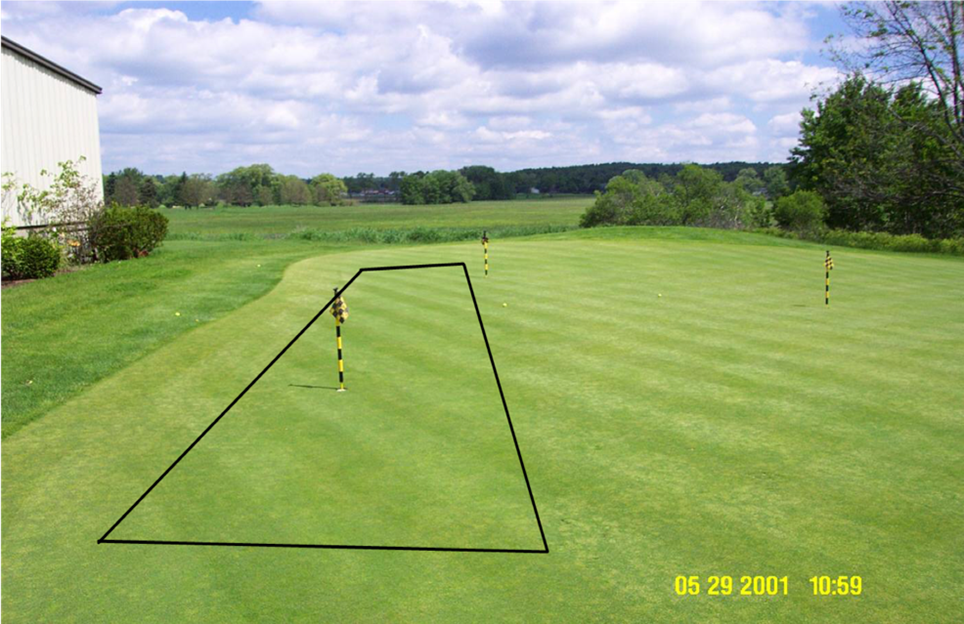
Since 2001, I’ve believed we should reduce the dilution rate to 1 gallon per 1,000 sq ft (1 gal/M). In my application, I sprayed 35 gallons per acre. As we know, foliar absorption of ethephon can take up to six hours under ideal conditions.
I would also recommend timing your final application between the last week of April and the first few days of May.
Based on what we know today, the combination of Anuew and ethephon is more effective than using trinexapac-ethyl alone. The Anuew combination delivers improved seedhead suppression and superior overall turfgrass quality (less bronzing).
Annual Bluegrass Weevil Control
The ABW GDD model uses a base temperature of 50°F, beginning March 1, to estimate adult movement and activity.
| Event | GDD50 |
| Adult migration begins | 40-60 |
| Peak adult activity | 80-150 |
| Typical Massachusetts peak | 100-120 |
Current Growing Degree Day Accumulation (Base 50°F)
| Location | Since March 1 |
| Springfield, MA | ~12-18 |
| Worcester, MA | ~10-15 |
| Boston, MA | ~12-15 |
I have been selling Suprado since March of 2023, and the results we’ve seen in the field have been better than advertised. The active ingredient, novaluron, is a chitin synthesis inhibitor. Chitin is a critical component of an insect’s exoskeleton and mouthparts, and when this process is disrupted, the insect cannot properly develop or molt. As a result, affected larvae are unable to form normal chewing mouthparts or a functional exoskeleton, which ultimately prevents them from successfully developing to the next life stage.
Research and field experience suggest that Suprado performs best when applications are made about one week after peak adult emergence. Waiting slightly allows most female adults to complete egg laying so the product can target the largest population of newly hatched larvae. In Massachusetts, peak adult emergence typically occurs around 100-120 GDD50. This places the recommended Suprado application window roughly between 120-170 GDD50.
As always, GDD models should be supported with field scouting. Soap flushes and monitoring of perimeter areas can help confirm adult activity and migration. In general, when timing Suprado, it is better to be slightly late than too early, as applications made too early may miss a portion of the larval population.
Bentgrass Germination In Cold Temperatures
In addition to Poa annua and ABW, I wanted to briefly discuss bentgrass germination. Optimal bentgrass germination occurs when soil temperatures remain consistently at or above 45°F for one to two weeks. While germination can begin at this lower threshold, it progresses much more rapidly as soil temperatures reach the low 50s or higher. When planning seeding, target sustained periods of warmth; brief temperature spikes are not sufficient for strong establishment (Purdue University, Michigan State University, UMass, Penn State).
Penncross bentgrass germinates more slowly under cool conditions compared to newer cultivars. In trials, improved cultivars reached approximately 50% germination within 14 days, whereas Penncross required closer to 30 days. Additionally, newer cultivars demonstrated superior spring green-up and faster establishment, highlighting their advantage for early-season seeding (University of Minnesota).
Cold, wet soils also increase the risk of damping-off, particularly in areas with excessive moisture or poor drainage. Foliar-Pak Grow-In 8-4-5 is one product to consider. It’s a liquid fertilizer designed to boost turf establishment, particularly in cool conditions. It combines N, P, K, micros, amino acids, and seaweed extract. It’s applied every 7-14 days from 6 to 9 fl. oz. per 1,000 sq. ft. It supports root growth that might be slower due to cold soil temperatures. One final note: the optimal C3 turf root growth range is 50-65°F, and the optimal C3 turf shoot growth range is 55-75°F.