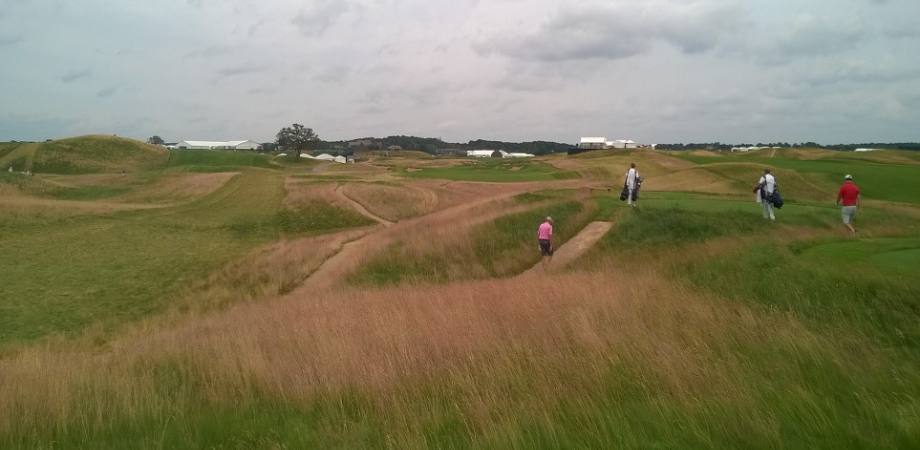
Effectively managing native areas is easier said than done. Here are a few suggestions and anecdotes to help you keep them in good order.
Check Your Soil Quality
If you want to have successful native areas, you need to have a deep understanding of your soil quality. Conduct a soil test to determine pH, calcium load, and even soil texture. Once you have that information, you’ll have a better understanding of what growth will look like.
Some of the best native areas in my territory, New England, are on sites where the soil is rocky and sandy; they don’t hold much water and the soil is nutrient deficient, which helps manage growth. On the other hand, your soil can be too good. I have a couple of customers who have great-looking native grasses in June, but they are difficult to play out of. By the end of June and into July, they have a lot of lodging from excessive growth because the soil is way too rich.
Mow Properly
How you mow is going to be entirely dependent on how fertile the soil is and what kind of spring you have. There will be a lot of ‘if, then’ statements. For example, this year in New England, we had 10 inches of rain in May. In previous years, that average was about one or two inches; that’s a huge difference. So, this year, most of my customers mowed twice—once in early or late April, and then again around Memorial Day to set themselves up for a better, mostly complaint-free summer. Note that most customers spray something after each mowing event.
Unlike the standard two to three inch deck height you’d use on the rough, you’ll set your deck to six inches. My customers will mow at this height and then dispose of the clipping yield. This is important because regular turfgrass leaves contain around 5% nitrogen, and since being deficit-based is so important for native areas, getting rid of the extra ‘food’ helps keep growth in check. This step is just as important as using plant growth regulators (PGRs), which we’ll cover later.
From mid-September to November, everyone mows their native areas at least one to two times, removing clippings from the area each time. This further reduces nutrient cycling and broadleaf weed competition.
Ensure They’re Moderately Playable
Slowing down the invasion of grasses like bluestem is important from a playability aspect. If you hit your ball into a native area, you want to be able to get it back out, right? Bluestem, a warm season perennial, self-seeds like crabgrass each summer. Many customers have too much bluestem in their native areas. In severe instances, by the middle of August, it’s up to my kneecaps. If you have a really tight stand of bluestem and lose your ball, you’re not going to hit a shot out of there even if you do manage to find your ball. This, of course, isn’t just limited to bluestem.
That’s the feedback my customers are getting from their golfers, so my customers are framing their programs around ensuring that their native areas look great and are semi-playable. Of course, hitting a shot out of a native area isn’t easy (nor should it be), but making sure it’s possible to hit a ball in there and advance it is their top priority. That’s where control comes into play.
Control Weeds and Unwanted Grasses
In the spring, my customers by and large use Quali-Pro’s Flumishield SC. Here in New England, that product is either put out in November as the grass goes dormant, or in March when the grass is still dormant. It’s a neat product because it hurts the undesirable grasses (and some weeds) that don’t belong in native areas, like bluegrasses, ryegrasses, and bentgrasses.
After my customers put that out in March, they’ll put down Dimension (dithiopyr) or pendimethalin in April or early May. Many opt for pendimethalin, mixing it with a high rate (32 fluid ounces per acre) of paclobutrazol, which is a growth suppressant, and NativeKlean. NativeKlean is an herbicide designed specifically to control and suppress broadleaf weeds in native areas. It has a three-month residual and controls the weeds on the front end. Some of my customers will mix their paclobutrazol with other PGRs like Aneuw or trinexapac-ethyl to slow down growth even more.
If a customer has poor soil quality (bad pH, low calcium, etc.) they’ll usually follow that program to a ‘T’, while customers with very good soil quality will tweak it as they see fit. It’s common to make two of these applications in the spring, and then mow, which leads into my next point.
Beware of the Tick
Ticks love tall grasses, and players hate ticks. It’s a good idea to use pyrethroid insecticides to fight ticks in your native areas. Although the residuals of those products are not incredibly robust (two to three weeks, tops), spraying for ticks can put your members at ease about entering a native area to find a ball. Many customers will walk through a native area with a white towel (it’s easy to see ticks on it) to test the tick activity in that area.
Triple Crown has two pyrethroids in it, in addition to a neonicotinoid, which boosts its contact ability. In addition to ticks, it’s labeled for chinch bugs, sod webworms, fall armyworms, cutworms, and other insects that find their way into native areas.
Some Tips for Controlling Specific Weeds and Grasses
- Controlling milkweed is a challenge due its deep rhizomatous root system. Of course, glyphosate can be used to spot treat milkweed. On the other hand, if you want to preserve adjacent grasses, use something with triclopyr in it. Maybe you want to let it grow, though. I have customers that like to see monarch butterflies, so they leave it alone.
- For deertongue, you’ll have to use a non-selective herbicide like glyphosate or fluazifop and hit it repeatedly until it’s gone. That means using a backpack sprayer with a small amount of blue dye and going to each individual plant, which will avoid damaging desirable grasses.
- BASF’s Finale has become increasingly popular among my customers for quackgrass control. It has shown promise for some customers at low rates, but your results may vary.
- Dallisgrass is getting a foothold here in New England, and Pylex can do a great job of controlling it when two to three spot applications are made mid- to late summer.
- Segment II has shown some promise in controlling bluestem, but more research needs to be done. Some customers have seen success when making three applications, three weeks apart, and at the label rate.
- One mix I plan on incorporating into my programs next year is Sure Power, paclobutrazol, and Dimension. That mix has provided good chemical suppression that allows for a great, fuzzy appearance in native areas, while still making it easy to see a ball inside it. Plus, it’ll destroy a wide range of broadleaf weeds.
Remember that every course is different. For product and cultural suggestions tailored to yours, reach out to your ATS rep.