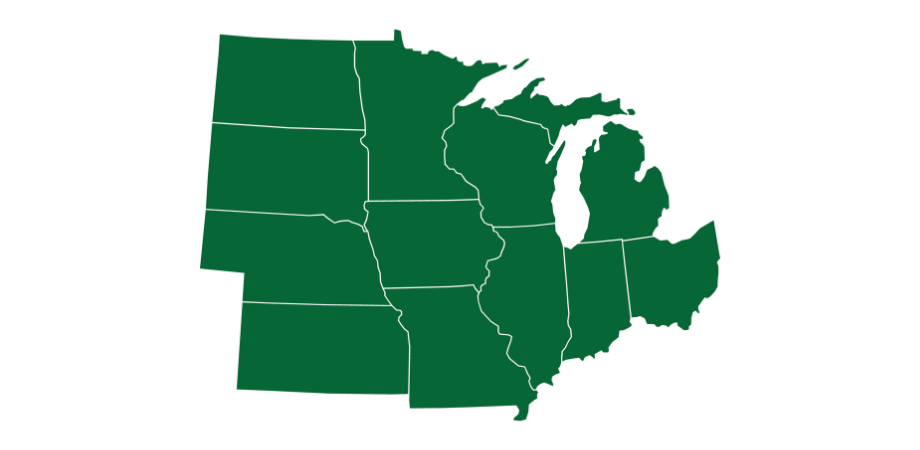
About halfway between Joplin and Springfield lies the city of Miller, Missouri. Justin Snider serves as assistant principal, athletic director, and baseball coach to a student body of around 200 at Miller High School. The school may be small, but his dedication to top-notch sports fields is notable.
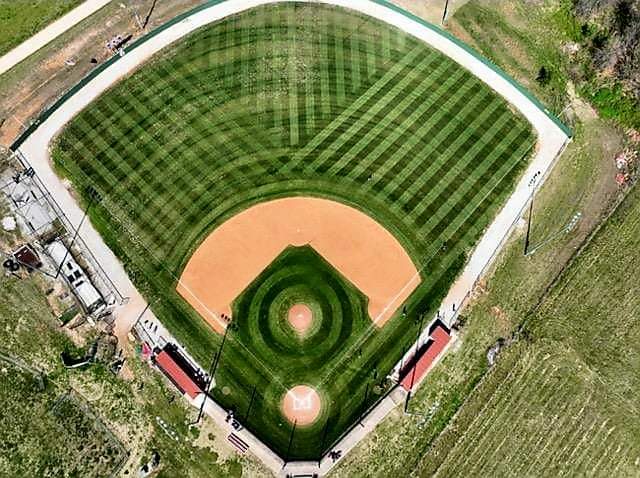
The school’s baseball field in particular has earned a lot of compliments from spectators, leading to statewide recognition. Miller’s baseball field was named the Missouri High School Baseball Coaches Association’s (MHSBCA) Grass Field of the Year for 2024.
“It makes you feel like your hard work pays off,” said Snider about winning the award. He quickly recognized the contributions of others, too, saying, “Our coaching staff helps, our players help, and then our superintendent and school board are amazing.”
This isn’t the first time Snider has won the MHSBCA’s Field of the Year award. In 2021, he earned the award when he was at Clever High School. In fact, he’s the only person to win the award twice.
Making His Way to Miller
With 2025 marking his 20th year in education, Snider has worn plenty of hats—and has learned a lot about what it takes to manage a field.
“At first, I didn’t know a lot about grass or what I was doing,” said Snider. “I didn’t really start diving into grass until I got to Clever [School District] in 2011.”
When he was coaching before his time at Clever, Snider recalled taking a farm roller, attaching it to the back of a UTV, and simply rolling the field. This earned him praise, but he knew there had to be more to it. Once he arrived at Clever, he met with a friend in the landscape business and a player’s father, who was a golf course attendant. That conversation helped him learn more about the different types of turfgrass and how to maintain a field.
“It probably wasn’t until 2018 or 2019, when I met Brian Winka through ATS, that I really started developing a plan and getting more involved in that aspect,” said Snider. “So, I really was a guy that, 20 years ago, had no idea what I was doing, and now I feel like I can make grass turn green anywhere.”
After spending time at other rural schools in southwestern Missouri, Snider came to Miller in 2022. Snider hadn’t seen the field before he got the job but knew that the district had purchased some land and constructed the baseball field, along with a softball field, near the end of the Great Recession. The field is primarily fescue and rye, along with a mix of Kentucky bluegrass.
Reflecting on starting at Miller, Snider said, “One of the first things our superintendent said was, ‘I’ve heard you know how to work fields. Can you make our football, softball, and baseball fields look good again?’”
“When you’re at a small school, more people have to do more things, and sometimes you just have to get together and develop a plan, and people have to stick to that plan to make something nice,” said Snider. “So, the first thing I did was call Brock Phipps, who I had worked with during my last year at Clever. We brought Brock out, developed a plan, and the progress pictures are pretty amazing.”
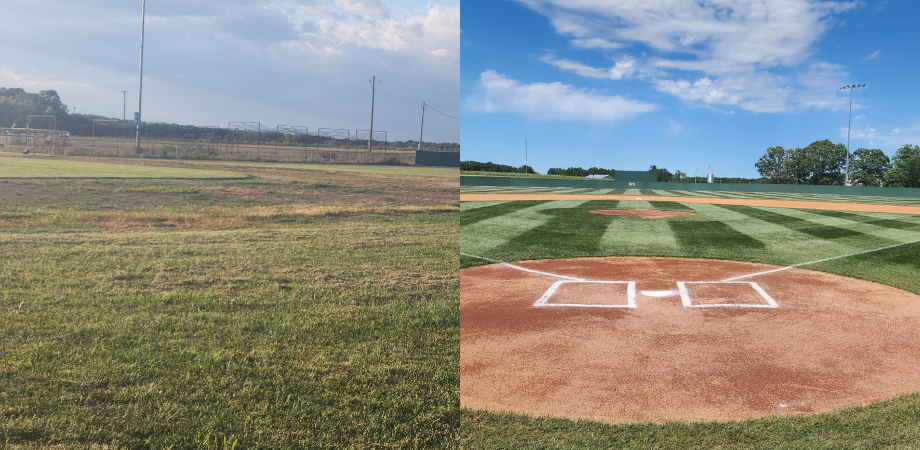
“I don’t think that tells the whole story, though,” Snider continued. “ATS helps us with all three of our playing surfaces: softball, baseball, and football. We get just unbelievable compliments, especially with so many people moving to artificial turf, about how nice our playing surface is on the football field as well.”
Dealing With Changing Conditions
It’s no secret that the Midwest sees its share of wild weather, and that fact often presents a challenge for Snider.
“[Weather is] hands down our biggest challenge,” said Snider. “We could start a game at 65°F, and by the time we’re done, it could be in the 30s. So, between rain, snow, and temperature changes, we get the whole gamut here in Missouri.”
Taking care of the infield soil is a vital part of making sure the field is always ready for play—no matter what the forecast says.
“You have to be able to take an inch or two of rain overnight and play the next day,” said Snider. “To do that, we make sure that our fields are dragged every day. Before practice and after practice, before a game and after a game, we nail drag it and open it up to get air down into it.”
Moisture management is also a unique challenge due to how the field is constructed.
“Here at Miller, we have a decent irrigation system, but we do not have a great hose system to water consistently,” explained Snider. “As we get warmer—it’s not that big of a deal in the spring—but in the summer, it is a lot to make sure our moisture management is consistent with what we need for a safe playing surface. That’s the toughest thing that we deal with in the May, June, and July time period.”
All this dedication ensures that the fields are ready and safe for practices and games—and there are a lot.
Staying Busy
Between March and May, the field sees a lot of traffic, especially since the field is used by both the high school and junior high teams.
“There’s probably around 40 nights or so of games played,” said Snider. “The field also has practices around six days a week.”
One of the busiest times on the field is during their tournament, which sees 16 to 18 games played in a one-week period right before their district play begins. This heavy traffic can lead to some recovery issues, with Snider saying that wear appears the most in front of the pitcher’s mound and up the first baseline, since the field has grass baselines.
“I always make sure we do an extra fertilization on the infield right after that time period just to make sure the grass stays healthy and gets what it needs,” said Snider.
The Trust Factor
When asked about the advice he’d give blossoming field managers, Snider said, “I think that the number one thing you better do is develop a plan and rely on people that are smarter than you.”
When it comes to products and advice, Snider trusts the ATS team to steer him in the right direction.
“I may not know exactly what on earth this chemical does, or what it means, but I trust that if it’s on the plan, that it’s needed,” said Snider.
Snider’s plan includes Foliar-Pak products and ATS1000 infield conditioner.
“I’ve really been happy with those products for the last four or five years, and they’ve done really well,” said Snider. “I trust Brock and Brian wholeheartedly.”
What’s Next
While there are no major plans for the field itself in the near future, the facility is getting a big upgrade.
“We are adding a press box, concession stand, and bathrooms, which will make the general area look complete and very professional,” said Snider. “We are a really small school, so we definitely take pride in all of our athletic fields and we’re really blessed that our school board and superintendent are really gung-ho about making our athletic fields and playing surfaces look so good.”
Being in a small community also means that the effort Snider, the team, and others put into making the field beautiful and safe is known and appreciated.
“The community takes a lot of pride in how our fields look, and it’s nice to be in a community like that,” said Snider. “Miller’s a really great place to be, and I’m very fortunate and lucky to be there.”
Snider also shared his appreciation for ATS.
“I just really appreciate all the work that ATS does for us, and the little guys. You know, they don’t have to spend time with us. We’re not big spenders like some of the bigger districts are, but at no point in my life, whether it was at Clever or Miller, did I ever feel like we were treated differently to the big schools. That means a lot to me specifically, and I know our rural schools appreciate that as well.”
To find out how ATS can help you, find a rep near you.