
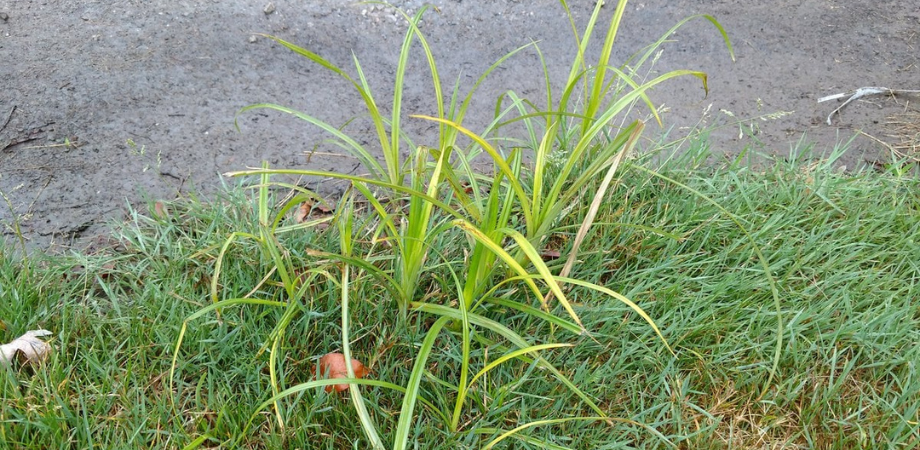
Yellow nutsedge is a very stubborn perennial weed. It poses big problems for lawn care operators due to its persistence. I’m going to cover common questions I receive about this weed, and then go over how to try to manage it effectively.
When does yellow nutsedge start to appear?
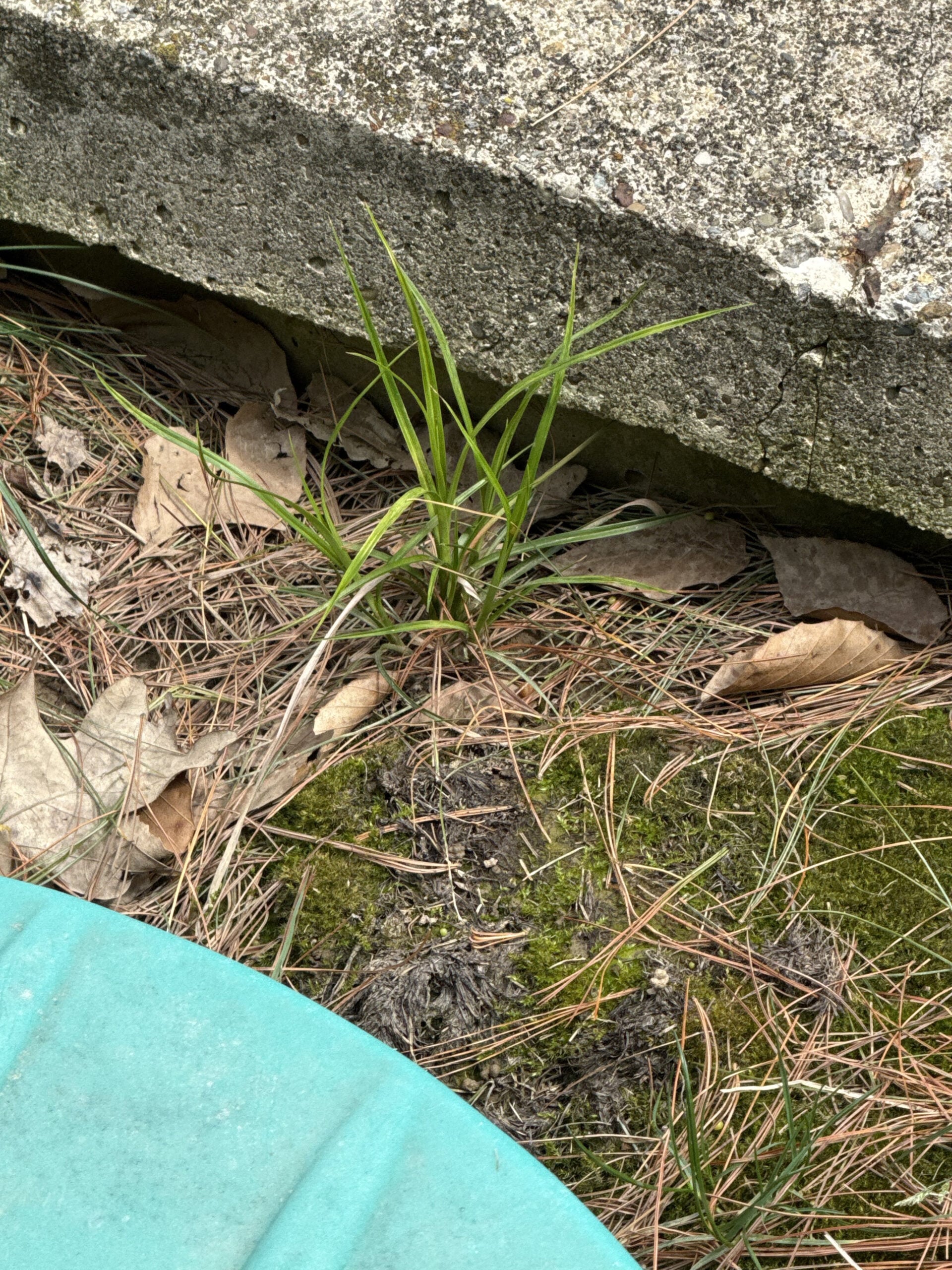
Yellow nutsedge’s tubers germinate when the soil temperature (at two inches deep) reaches 54°F. In a lot of places, that occurs in May. However, in microclimates, it can be earlier. Examples of these “climates” are south-facing slopes, against brick homes, or in black mulch beds. This year (2026) in Northeast Ohio, I had a customer send me the picture below before tax day. That specimen is in mid-season form!
How can I identify yellow nutsedge?
The quintessential features are the plant’s triangular stems and its waxy, pointed, three-ranked leaves. The plant also produces a tall yellow flowerhead, for which it’s named. The Ohio State University and Purdue University both have good write-ups on and photos of yellow nutsedge.

What conditions make a perfect environment for yellow nutsedge?
In general, yellow nutsedge thrives in wet areas. You’ll see it pop up frequently in low-lying properties, ditches, and in any soils that tend to hold more moisture.
Unfortunately, though, it is very adaptable. It can grow in almost any soil type, almost anywhere. For example, I frequently fight this weed near my driveway edge, which is a heat sink. Despite that area not being excessively wet, the nutsedge tends to overwinter better and germinate regularly, since the soil is warmer by the concrete.
What challenges make managing yellow nutsedge tough?
It’s a sneaky plant in that it resembles grass and can be easily missed during treatment, especially when it’s young. At its start, yellow nutsedge grows faster than most cool-season grasses, so any accidental skips during treatment quickly become apparent. I have actually had customers be blamed for “not mowing the ditch” when, in fact, they had, but the dominant species in said (untreated) ditch was yellow nutsedge, and it just grew faster.
Yellow nutsedge aggressively and continually germinates throughout its growing season. When tuberization occurs (late summer or early fall), it rapidly reproduces the vegetative propagules (nutlets/tubers) from which it stems in the following years. A single plant can produce hundreds of tubers in one season, and those tubers often remain viable for several years.
Yellow nutsedge is further interesting in that it produces a variety of allelopathic chemicals. Sometimes, these natural compounds give the sedge a competitive advantage over neighboring desirable plants. If soil conditions aren’t conducive to sedge survival (drought), some of these allelopathic chemicals will also cause it to suppress itself in an effort to keep its tubers from germinating, thus helping propagules stay dormant until conditions improve.
Regarding treatment, many of the best-labeled control products are very slow-acting. This can be good in that the active ingredients are more thoroughly killing the weed, or it can be bad in that it may give clients the misconception of a poor job/product.
What’s the best way to manage yellow nutsedge?
I tell my customers that there are two weeds that should not be part of your standard program offering to clients: yellow nutsedge and wild violets. These weeds both need to be treated supplementally and charged for separately as an ‘a la carte’ option due to how complex they are to fight.
Broad-spectrum herbicides like 4-Runner and All-Star will control a lot of nuisance weeds while also beating on yellow nutsedge, which makes them an excellent first strike in the effort to manage this species.
Celero has been one of my go-to products for several years now to more thoroughly manage yellow nutsedge. I don’t like using the word control because dealing with nutsedge is not a ‘one-and-done’ deal. That said, Celero has really helped reduce the amount of nutsedge in my yard year over year.
A newer product that’s starting to get traction is Arkon. It functions initially as a growth regulator, preventing nutsedge from growing quite as fast. Over time, the weeds will start showing more signs of damage and disappear.
Your ATS rep will work with you to develop a personalized program based on your geography, soil type, and goals. Reach out to them today to get started.


