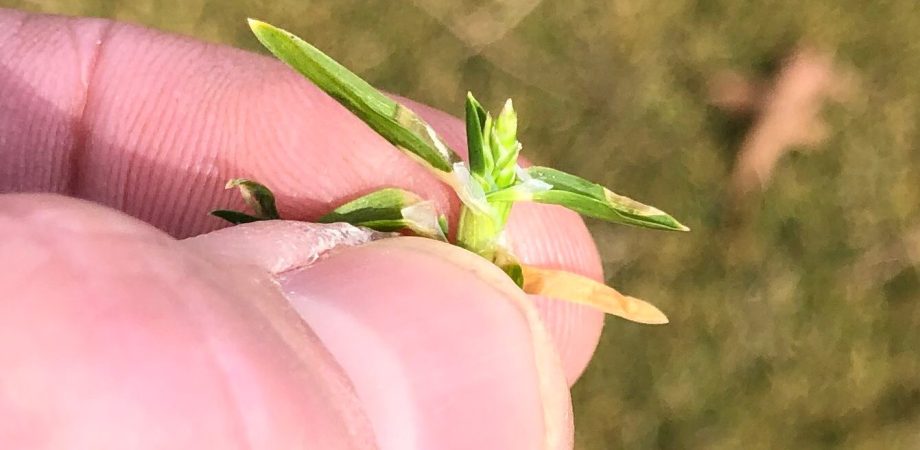
Annual bluegrass putting greens are arguably one of the best putting surfaces to play on, but not from late April to late May. Why? Seedheads. This is not a new problem for the golfer. Complaints regarding seedheads affecting playability have been noted as far back as 1937! It remains a massive challenge to provide excellent putting surfaces during seedhead season. Fortunately, our industry has come a long way over the past 25 years.
What do we know about Poa annua? It’s a winter annual that germinates in the fall as soil temperatures drop below 70°F (Kaminski 2019). It lives through the winter and produces seedheads in the spring. To make matters worse, a typical Poa green could produce 14 to 63 million viable seeds per thousand square feet per year! (Lush 1989). These seeds can also be viable years later. During the seedhead growth phase, carbohydrates are diverted to produce seed rather than producing roots, tillers, etc. This energy diversion is noted by off-color Poa, uneven putting surfaces, and inconsistent playability because each tiller that produces seedheads eventually dies as it completes its lifecycle (Soika 2004).
Stopping seedhead development every spring is the goal for most superintendents. If they are successful, the golfer enjoys a more uniform, consistent putting surface, and the superintendent builds a more stress-tolerant, disease-resistant plant. That is a “win-win” for sure, but achieving that goal has been extremely challenging. My father was a superintendent for over 40 years, and Poa was the enemy in our home. He tried using many different products to turn the tide on the Poa invasion and seedhead development.
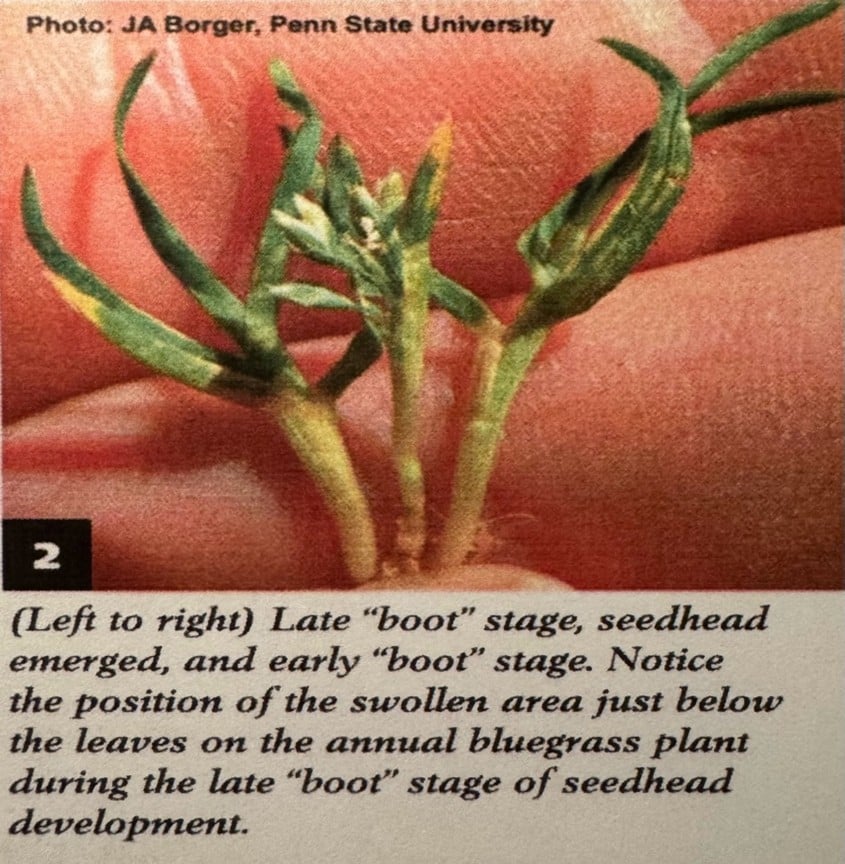
Like every superintendent, he tried in vain to time the application by watching for the boot stage to begin applications. The boot stage is the period before the seedhead is visible, but the sheath is swollen and contains the developing seedhead. The goal is to apply ethephon and a plant growth regulator (PGR) before the seedhead is in the boot stage (Picture 1., Soika 2004). Searching for the boot stage on a plant that’s mown at 0.125 inches is not an easy accomplishment. Like his friends, he was never satisfied with 50-60% seedhead control. Plus, the turf looked yellow, which created many questions from members just trying to understand the process. He read the research from Penn State and others, but could never achieve the level of control that was published. Some of his fellow superintendents were also using permeable green covers. By the time covers were removed in late winter, the turf looked like it was in mid-season condition, and the boot stage was in high gear. Ethephon and PGR applications were made, but with limited success. There were a lot of inconsistent results due to trying to get the timing right.
In early 2003, turfgrass research confirmed a growing degree day (GDD) model that could time PGR applications to suppress seedheads. Research from Penn State University, Michigan State, and Virginia Tech clearly showed that ethephon/PGR applications could achieve a very high level of seedhead suppression if the model was followed. Many golf course superintendents, however, still struggled to achieve the level of control shown at the research facilities.
In 2013, I was fortunate to take a GCSSA seminar on PGRs taught by Dr. Eric Askew of Virginia Tech. His research clearly showed that making a late fall ethephon application in November or December, followed by two applications in the spring—starting at 250 GDD32—would dramatically improve seedhead control. The reason for the success is that ethephon only works to prevent seedhead production. The late fall application gets loaded in the plant before seedhead development occurs.
Today, ethephon/PGR applications are commonplace and seedhead reduction has improved dramatically, but we are still searching for even better turfgrass quality results. One such improvement was the introduction of Anuew EZ, which is foliar-absorbed but can regulate growth longer than ethephon. If you combine it with a product like ArmorTech PGR 113 MC, turfgrass quality and seedhead reduction are better. For optimum results, apply ethephon at five ounces per thousand square feet in mid- to late fall. In the spring, apply ethephon at five ounces per thousand square feet and Anuew EZ at 2.2 ounces per acre starting at 200-500 GDD32. Three weeks later, apply ethephon at five ounces per thousand square feet and Anuew EZ at 5.5 ounces per acre.
Several foliar tank mix partners can also improve turfgrass quality. One such product is Foundation Forty, by Foliar-Pak. It is built with specific amino acids that are rapidly absorbed by turfgrass leaves and has been shown to increase plant health and turfgrass quality without promoting top growth. Amperage is another great tank mix partner with Anuew/PGR applications because it promotes plant health and increases turfgrass quality without considerable top growth.
There are also many cultural practices like verticutting, grooming, and/or brushing to help stand the seedheads up, making it easier to mow and improve playability. During seedhead season, another common practice is to drop the mowing height once per week below the standard mowing height. Lowering the height by 0.015 inches will allow you to mow lower into the surface and harvest more seedheads.
Can we improve Anuew/PGR performance by considering spray nozzles? Consider looking into the Greenleaf DualFan nozzles if you are not already using them. They are a great choice for delivering foliar applications and are oriented 10 degrees forward and 50 degrees rearward to allow for greater foliar contact. This design provides much better coverage on both sides of the vertical leaf blade of Poa and newer bentgrass varieties.
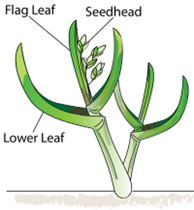
The flag leaf pictured below is the main ethephon target absorption site.
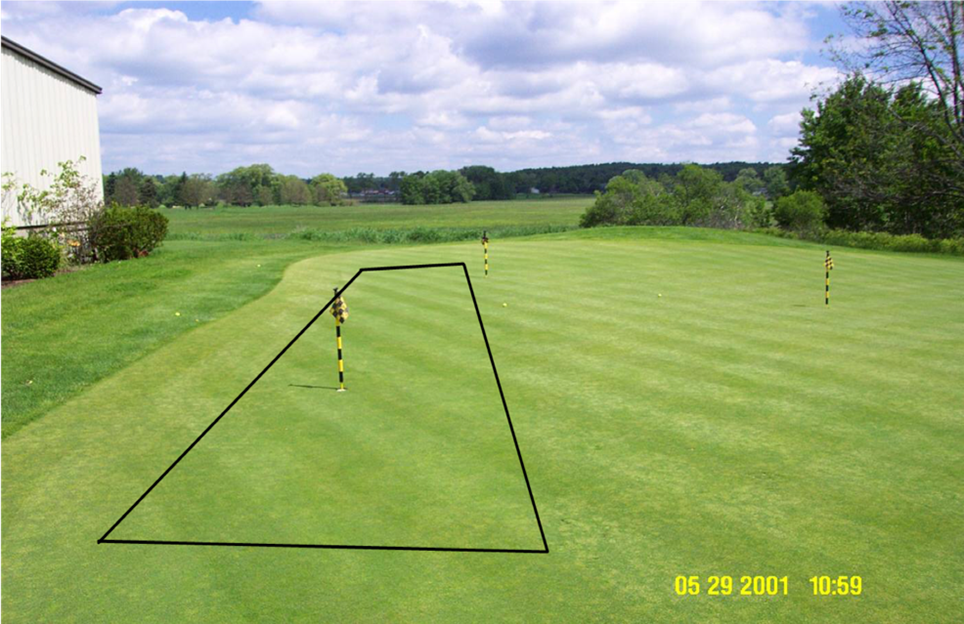
One more thought: I applied a specific ethephon product before it was available on the market as an experimental product on a sunny afternoon on May 3, 2001, using a CO2 backpack sprayer calibrated at 35 gallons per acre. I applied the product at five ounces per thousand square feet with a 4-0-1 liquid fertilizer at two ounces per thousand square feet. Mowing was delayed following the application for two days. The picture below, taken three weeks later, clearly showed the positive results. As a side note, I have not come across published research that compared dilution rates. I clearly missed the boot stage with the May application. Yet, I still had pretty good control.
Authored by Scott Mackintosh, M.S., CPAg
Sales Manager
Atlantic Golf and Turf, an Advanced Turf Solutions Company
References:
McDonald, A. Kowalewski, Ph.D., and Conner Olsen. M.S. 2019. Suppressing Poa annua seedhead production. Golf Course Management Magazine.
J.A. Borger, T.L. Watschke, and M.D. Soika. 2004. Suppress Seedheads on Bluegrass Putting Greens. Turfgrass Trends pages 78-81.
S.D. Askew. 2017. Plant Growth Regulators Applied in Winter Improve Annual Bluegrass (Poa annua) seedhead suppression on golf greens. Weed Technology 31(5), 701-713, (October 2017).
T.T. Lulis, K. Tang, and J.E. Kaminski. 2019. Penn State University. Control of Annual Bluegrass Seedheads on a golf course putting green using plant growth regulator products and growing degree day models.
W.M. Lush. 1989. Adaption and differentiation of golf course populations of annual bluegrass (poa annua). Weed Sci. 37:54-59